Paris Architecture Travel Guide: Must-See Places and Hidden Gems in Paris

Updated: Mar 27

Paris is famously known as "The City of Love," but this love isn't limited to romance, it extends to architecture. When I first visited Paris, I fell in love with its buildings, their unique designs, and the intricate details that define them. Every street and hidden corner reveals breathtaking structures, each with its own story to tell.
If you are an architect or simply an architecture enthusiast, Paris is a must-visit city. With its unparalleled blend of historical and contemporary design, you will find yourself returning multiple times just to take in everything it has to offer. From the Eiffel Tower to Sacré-Cœur, this city is a paradise for architecture lovers. But where should you start? This guide will take you on an architectural journey through Paris, exploring its most iconic landmarks from a design and engineering perspective, and also a few of my favourite ones. Let's travel to Paris together in this post!
The City Itself: A Masterpiece of Urban Planning

The layout of modern Paris is largely credited to Baron Georges-Eugène Haussmann, who redesigned the city in the mid-19th century under the orders of Napoleon III. His transformation of the city was revolutionary, replacing the medieval labyrinth of narrow streets with wide boulevards, creating a highly structured urban layout that remains one of the most recognizable in the world.
Haussmann’s work introduced uniform building facades with cream-colored limestone, wrought-iron balconies, and mansard roofs. His radial design ensured that key architectural landmarks, such as the Arc de Triomphe and Place de la Concorde, were visually connected by grand avenues. This new cityscape improved air circulation, reduced overcrowding, and facilitated the movement of people and goods.
His work had a bit of controversy, as it led to the displacement of many residents, but it also gave Paris its iconic aesthetic, making it an urban planning model studied worldwide. Today, exploring the city means walking through a carefully designed masterpiece where history and modernity coexist seamlessly.
Architectural Landmarks You Cannot Miss
Eiffel Tower
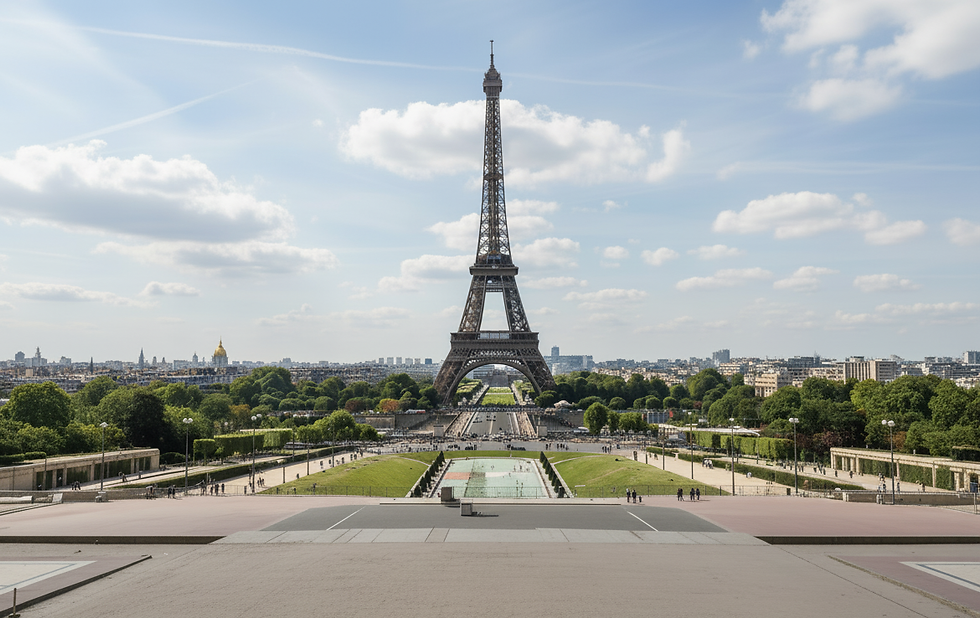
One of the most iconic structures in the world, the Eiffel Tower was designed by engineer Gustave Eiffel and built for the 1889 Exposition Universelle, marking the 100th anniversary of the French Revolution. The tower was initially criticized by many prominent artists and intellectuals, who viewed it as an industrial monstrosity, yet today it stands as a triumph of engineering and an enduring symbol of France.
Structurally, the tower is a marvel of 19th-century ironwork, composed of over 18,000 iron pieces held together by 2.5 million rivets. It stands at 330 meters (1,083 feet), making it the tallest structure in Paris. Eiffel’s innovative lattice framework allows the tower to withstand strong winds and thermal expansion without compromising stability. From an architectural perspective, its open framework was groundbreaking, influencing later skyscraper designs.
Visiting the tower provides a direct experience of iron engineering at its finest. Standing beneath it allows you to appreciate its delicate yet sturdy design, while ascending to its observation decks offers stunning panoramic views of the meticulously planned cityscape below.
Basilique du Sacré-Cœur de Montmartre

Located at the highest point in Paris, on Montmartre Hill, Sacré-Cœur Basilica was designed by Paul Abadie and constructed between 1875 and 1914. Unlike many of Paris's Gothic structures, it follows a Romano-Byzantine style, characterized by its massive domes, rounded arches, and ornate interiors.
One of its most fascinating features is its use of Château-Landon stone, which naturally exudes calcite when it rains, giving the basilica its characteristic bright white color. This self-cleaning quality ensures that Sacré-Cœur remains strikingly luminous against the Parisian skyline.
Architecturally, the basilica stands in contrast to Haussmann’s rigid urban plan, serving as both a spiritual sanctuary and an artistic retreat. Inside, it houses one of the world’s largest mosaics, Christ in Majesty, measuring 475 square meters. From an engineering standpoint, its foundation is an achievement in itself—built atop unstable gypsum deposits, it required deep underground pilings to ensure stability.
A visit here is essential not only for its architecture but also for the way it integrates spirituality, history, and engineering innovation.
Cathédrale Notre-Dame de Paris

Notre Dame de Paris is an emblematic cathedral that, beyond its spiritual and religious significance, is a major reference in the architectural world as one of the finest examples of Gothic architecture. A landmark as iconic as the Eiffel Tower for every visitor who goes to Paris.
Its construction dates back to 1163 and was completed in 1345. The cathedral is admired for its impressive rose windows with stained glass, the longevity of its structure, and its resilience through time. In 2019, it suffered major damage after a fire that destroyed a large portion of the wooden roof structure and the central spire; however, restoration efforts have aimed to rebuild it as close as possible to its original design.
From an architectural point of view, the cathedral is filled with Gothic elements both inside and outside. Features such as the rose windows, ribbed vaults, pointed arches, and especially the flying buttresses allowed the structure to reach unprecedented heights while supporting the heavy stone walls. These buttresses redirected the structural loads outward, making it possible to incorporate large stained-glass windows and bring natural light into the interior, a key concept of Gothic architecture.
The facade itself is carefully composed in three horizontal levels and balanced vertical towers, showing symmetry and proportion typical of medieval cathedral design. The sculptural details, including gargoyles and religious figures, were not only decorative but also functional, as some served as water spouts to protect the masonry from rain erosion.
Notre-Dame, more than a church, it represents the technological ambitions and craftsmanship of medieval builders and remains one of the most influential religious structures in Western architecture.
Watch How Notre-Dame de Paris looked before the fire: Click Here
Hôtel des Invalides

Commissioned by Louis XIV in 1670, Hôtel des Invalides was designed by Libéral Bruant as a hospital and residence for wounded soldiers. Later, Jules Hardouin-Mansart added the grand Dôme des Invalides, completed in 1708, making it one of the most stunning examples of French Baroque architecture.
The dome, covered in 12 kilograms of gold leaf, remains one of the most magnificent cupolas in the world. The influence of St. Peter’s Basilica in Rome is evident in its symmetrical design, intricate frescoes, and grandeur.
From an architectural perspective, the structure represents power and prestige. Today, it also serves as the final resting place of Napoleon Bonaparte, whose monumental sarcophagus is placed beneath the dome.
Visiting Hôtel des Invalides allows you to see how Baroque architecture was used to create both an imposing military institution and an enduring monument to France’s history.
Louvre Museum

Originally a medieval fortress in the 12th century, the Louvre became a royal palace before being transformed into the renowned museum that we all know today. The building is an architectural tapestry, reflecting the Renaissance, Baroque, and Classical styles that defined French architecture over centuries.
Perhaps the most striking addition to the Louvre is the modern glass pyramid entrance, designed by I. M. Pei and completed in 1989. The pyramid, a daring contrast to its classical surroundings, serves as both a functional entrance and a symbolic statement of the museum’s evolution.
Over the years, the Louvre has become an experience, isn’t just about seeing art—it’s about walking through architectural history, from medieval walls to Renaissance grandeur to modernist transparency.
Palais Garnier (Opéra de Paris)

Completed in 1875, Palais Garnier is one of the most extravagant architectural works in Paris. Designed by Charles Garnier in the Beaux-Arts style, it embodies the theatricality of opera itself. Every element of the building is ornate, from its grand marble staircase to its gilded balconies and painted ceiling.
Apart from its breathtaking design, the Opera also has one of the most fascinating architectural secrets lying beneath it: the famous "underground lake." This man-made cistern was created during the construction of the opera. The architect, Charles Garnier, encountered severe groundwater flooding that represented a threat to the foundations of the building. Therefore, in order to control this situation, engineers created a permanent underground reservoir to help stabilize the soil and reduce the hydrostatic pressure (the pressure that the water was making against the structure, weakening it). Although it is not a natural lake, people call it this way to refer to it. This engineering innovation also served as inspiration for the famous novel The Phantom of the Opera.
For architecture lovers, visiting Palais Garnier is essential to appreciate how performance spaces were designed not just for acoustics but also for dramatic impact.
Arc de Triomphe

Commissioned by Napoleon in 1806 and completed in 1836, the Arc de Triomphe was designed by Jean Chalgrin, inspired by ancient Roman triumphal arches. Its massive scale and detailed bas-reliefs commemorate key battles and victories of the Napoleonic era.
The arch’s engineering is impressive in its massive stonework and intricate carvings, which depict soldiers in motion, creating a sense of movement and depth. Climbing to the top provides an unparalleled view of Haussmann’s city layout, revealing the radial symmetry that defines Parisian urbanism.
Even More Architectural Marvels (Bonus)
Château de Versailles

Located just outside Paris, the Palace of Versailles is one of the greatest examples of Baroque architecture, commissioned by Louis XIV and constructed between 1661 and 1682. Designed by Louis Le Vau, André Le Nôtre (for the gardens), and Charles Le Brun (for the interiors), Versailles was created to symbolize the absolute power of the monarchy.
The palace’s grandiose Hall of Mirrors, expansive gardens, and intricate interiors all reflect the height of royal opulence. The gardens, meticulously designed with fountains, sculptures, and geometric patterns, complement the palace’s symmetry, creating a cohesive visual experience.
The impressive scale and attention to detail in Versailles make it a testament to the extravagant ambition of French royalty. Its massive size and grandeur are intended to project the king's power, making Versailles not just a royal residence but also an architectural statement.
Pantheon
The Pantheon is a masterwork of neoclassical architecture designed by Jacques-Germain Soufflot. Constructed between 1755 and 1790, the building originally served as a church dedicated to St. Genevieve and was later transformed into a mausoleum for prominent French figures such as Voltaire, Rousseau, and Victor Hugo.
Its most striking feature is the grand dome, an engineering feat of the 18th century. Supported by a series of intersecting arches, it is one of the largest domes in Europe. The Pantheon’s blend of classical and innovative design, such as its Corinthian columns and the monumental portico, exemplifies the ideals of symmetry, balance, and harmony inherent in neoclassical architecture.
The Pantheon remains a symbol of both national identity and the enduring influence of classical design on French architecture. A visit offers a unique chance to explore the convergence of history, art, and innovative engineering.
La Défense

La Défense, also known as the modern business district of Paris, is a neighborhood where you temporarily escape the classical architecture that characterizes most of the city and enter a completely different architectural language. Located just outside the historic center, this district was intentionally developed to accommodate high-rise construction that is restricted within central Paris.
One of its most emblematic structures is the Grande Arche. Completed in 1989 and designed by Danish architect Johan Otto von Spreckelsen (later completed by Paul Andreu), the Grande Arche is a monumental cube-shaped structure standing about 110 meters tall. Rather than functioning as a traditional triumphal arch, it was conceived as a modern interpretation of one — dedicated to humanity and humanitarian ideals rather than military victory. Its minimalist geometry and clean lines strongly contrast with the historic architecture found in central Paris.
However, La Défense is not only about the arch. The district itself functions as an open-air exhibition of contemporary architecture. Skyscrapers with glass curtain wall facades, reflective towers, experimental forms, and large-scale office complexes define the skyline. Because the area was master-planned, pedestrians circulate mainly on an elevated plaza separated from vehicular traffic below, making the public space highly walkable. Between the towers, you will also find landscaped plazas, urban parks, fountains, and large public art installations.
La Défense reveals the evolution of Parisian architecture. It demonstrates how the city protects its historic identity while still allowing architectural experimentation and modern development. Rather than competing with historic Paris, La Défense complements it — showing that Paris is not only a museum of the past but also a living, evolving architectural capital.
La Quartier Latin
The Quartier Latin is a neighborhood that receives its name from being a place where the language spoken was mainly Latin. It is considered one of the most historical and culturally rich neighborhoods in Paris, as it hosts the renowned Sorbonne University. The area is characterized by its cobblestone streets, medieval architecture, and its role as a hub for intellectuals and artists throughout history. This district features a mix of medieval buildings, Renaissance courtyards, and iconic academic institutions dating back to the 12th century.
Architecturally, the Quartier Latin presents a contrast between its ancient structures and the modern needs of a vibrant, youthful district. Key landmarks such as the Panthéon, the Lycée Louis-le-Grand, and the Saint-Étienne-du-Mont church showcase a blend of Gothic and classical styles, demonstrating the evolution of architectural trends over centuries.
A visit to the Quartier Latin is a must for architecture lovers, offering a glimpse into Paris’s intellectual history and the harmonious mix of old-world charm and modern vibrancy.
Les Catacombes de Paris

The Catacombs of Paris, an underground ossuary located about 20 meters below the city, provide a chilling yet fascinating example of underground architecture. Although this is not a traditional building, it represents an urban solution that responded to the needs of the city over two centuries ago. It extends beneath a large portion of Paris. Originally, the tunnels were limestone quarries, but they were repurposed in 1785 to alleviate the severe overcrowding of Parisian cemeteries.
This urban solution began after serious health concerns arose in the city due to the accumulation of bodies in overcrowded cemeteries. Instead of adding more burial grounds within the city, authorities decided to reuse the abandoned quarry tunnels. The catacombs stretch for miles beneath Paris and contain the remains of over six million Parisians. The arrangement of these bones, organized in structured patterns, showcases both an eerie sense of artistry and an unusual solution to a growing urban problem. The transformation of these quarries into an ossuary is a unique example of architecture being redefined for a purpose beyond its original function.
Nowadays, the Catacombs are no longer used as cemeteries, but a portion of them is open to the public, allowing visitors to walk through the underground galleries surrounded by centuries of history. It is a truly unique architectural experience.
Et Voilá...!
Paris is an open-air museum of architecture, history, and art, where every corner tells a story of artistic ambition, engineering innovation, and historical transformation. Apart from this list of places, you can also discover interesting and breathtaking spaces simply by walking through its streets.
Whether you're admiring the city's urban planning from the top of the Eiffel Tower or appreciating the beauty of architecture itself at the Opera House, this city won’t let your architectural spirit be disappointed. Instead, it will continue to surprise you and captivate you with endless marvels across the city.


Comments